Goodnote Font Evaluation
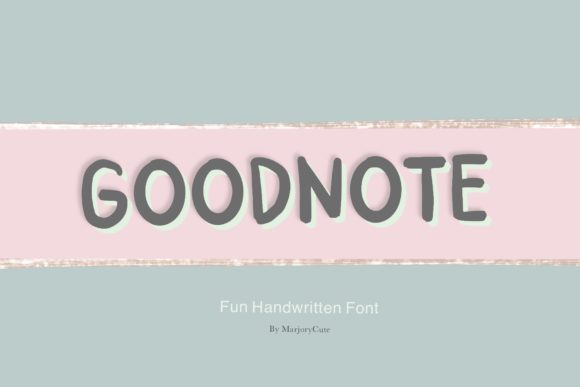
When selecting a typeface for a project, designers often face the challenge of balancing functionality with personality. Goodnote is a simple and a bit quirky handwritten font that has carved out a specific niche in the digital typography market. Neat and friendly, this font will complement any children or school design that you wish to create. However, before committing to it for a long-term project, it is essential to understand its structural characteristics, its intended use cases, and how it compares to other handwriting styles available today.
Understanding Goodnote's Design Philosophy
Goodnote distinguishes itself through a unique blend of legibility and organic charm. Unlike rigid serif or sans-serif fonts that prioritize uniformity, Goodnote mimics the natural flow of handwriting without sacrificing clarity. The characters are constructed with slight variations in stroke width and alignment, giving the text a human touch that automated systems often struggle to replicate.
The font's "quirky" nature comes from subtle irregularities in letter spacing and terminal shapes. These features prevent the text from looking sterile or overly manufactured. At the same time, the "neat" aspect ensures that the script remains readable even at smaller sizes. This duality makes it an excellent candidate for educational materials where clarity is paramount, yet the tone should remain approachable rather than academic.
Why Designers Choose Goodnote
There are several practical reasons why a designer might select Goodnote over more traditional scripts. The primary driver is often the need to establish a specific emotional connection with the audience immediately.
- Approachable Aesthetic: In environments like preschools, tutoring centers, or children's book illustrations, a standard block font can feel intimidating. Goodnote softens the visual experience, making content feel more inviting.
- Visual Hierarchy: Because the font stands out from standard body text, it serves as an effective tool for headlines, pull quotes, or section dividers. It breaks the monotony of a page filled with generic sans-serif text.
- Brand Personality: For brands targeting families or students, Goodnote helps communicate values of creativity, learning, and friendliness without requiring complex graphic elements.
Furthermore, the font's versatility allows it to be used across various media formats. Whether printed on worksheets, displayed on a mobile app interface, or used in social media graphics, Goodnote maintains its distinct character while remaining functional.
Benefits and Tradeoffs
Evaluating any typeface requires a balanced look at its strengths and limitations. While Goodnote excels in specific contexts, it is not a universal solution for all design problems.
The most significant benefit of Goodnote is its ability to convey warmth. It reduces the cognitive load associated with reading dense text by adding a layer of visual comfort. This is particularly beneficial for younger readers who may find standard fonts difficult to engage with. Additionally, the font's open counters (the enclosed spaces within letters like 'o' or 'e') contribute to high readability, which is often a problem in more elaborate cursive scripts.
However, there are tradeoffs to consider. Because Goodnote is designed to look like handwriting, it lacks the strict geometric consistency of professional typesetting. In situations where extreme precision is required, such as legal documents or technical manuals, the slight variations in letterforms could be perceived as unprofessional. Moreover, the quirky nature of the font means it may not pair well with every other typeface. Overusing it or combining it with conflicting styles can result in a cluttered or chaotic layout.
Situations Where Goodnote Is a Strong Fit
To determine if this font aligns with your goals, consider the following scenarios where Goodnote is likely to perform exceptionally well.
1. Educational Materials
Worksheets, flashcards, and classroom posters benefit greatly from the friendly tone of Goodnote. When teaching phonics or basic math, the font's clear structure helps children focus on the content rather than being distracted by a harsh or impersonal typeface. It bridges the gap between formal instruction and playful learning.
2. Children's Publishing
In picture books or early reader novels, typography plays a crucial role in setting the mood. Goodnote can serve as the primary display font for titles and dialogue, creating a sense of intimacy between the story and the reader. Its neatness ensures that young eyes do not strain, while its quirkiness keeps the pages visually interesting.
3. Personal Branding for Creatives
Artists, teachers, and lifestyle bloggers often use Goodnote to personalize their digital presence. It adds a signature-like quality to logos or headers, suggesting that the content is handcrafted and curated by a real person rather than generated by an algorithm.
When Alternatives May Be Worth Considering
Despite its merits, Goodnote is not the right choice for every project. If your design needs to project authority, corporate stability, or high-tech innovation, this font may undermine those messages. For instance, a financial institution or a medical device manufacturer would likely find the casual nature of Goodnote inappropriate.
Additionally, if your project involves large blocks of body text, you should reconsider using Goodnote as the primary font. Handwritten styles are generally best reserved for short bursts of text, headings, or accents. Long-form reading is better served by highly optimized sans-serif or serif fonts that have been engineered specifically for sustained readability.
Finally, if you require a font that supports a wide range of languages beyond English, you must verify the character set coverage. Some handwritten fonts have limited glyph support, which can restrict their utility in global projects. Always check the font specifications to ensure it meets your multilingual requirements before purchasing or downloading.
Practical Decision-Making Insights
Selecting the right font is ultimately a decision about communication strategy. Before finalizing your choice of Goodnote, ask yourself a few critical questions regarding your target audience and the message you wish to convey.
- Who is reading this? If the audience includes young children or individuals seeking a relaxed atmosphere, Goodnote is a strong contender. If the audience expects formality, look elsewhere.
- What is the context? Is the text part of a quick glance (like a poster) or a deep dive (like a report)? Use Goodnote for the former, but reserve standard fonts for the latter.
- How will it pair? Test Goodnote against potential companion fonts. A clean, neutral sans-serif often works best alongside Goodnote to balance its whimsy with structure.
By approaching the selection process with these criteria in mind, you can avoid common pitfalls and ensure that your typography enhances rather than distracts from your content. Goodnote offers a charming and functional option for specific niches, but like any tool, its value depends entirely on how effectively it is applied to the task at hand.
Ultimately, the decision to use Goodnote should be driven by the specific needs of your project. If your goal is to create a design that feels personal, accessible, and focused on learning, this font provides a solid foundation. However, if your priorities lean towards strict professionalism or mass-market scalability, exploring alternatives may yield better results. Careful evaluation of these factors will lead to a more cohesive and effective design outcome.